
The Illusion of Clean Rivers: How One Legal Battle Exposed Noida’s Toxic Secret
On paper, Noida is a gleaming symbol of modern urban planning, filled with high-rise luxury societies and smart city initiatives. But beneath the surface lies a dark ecological crisis.
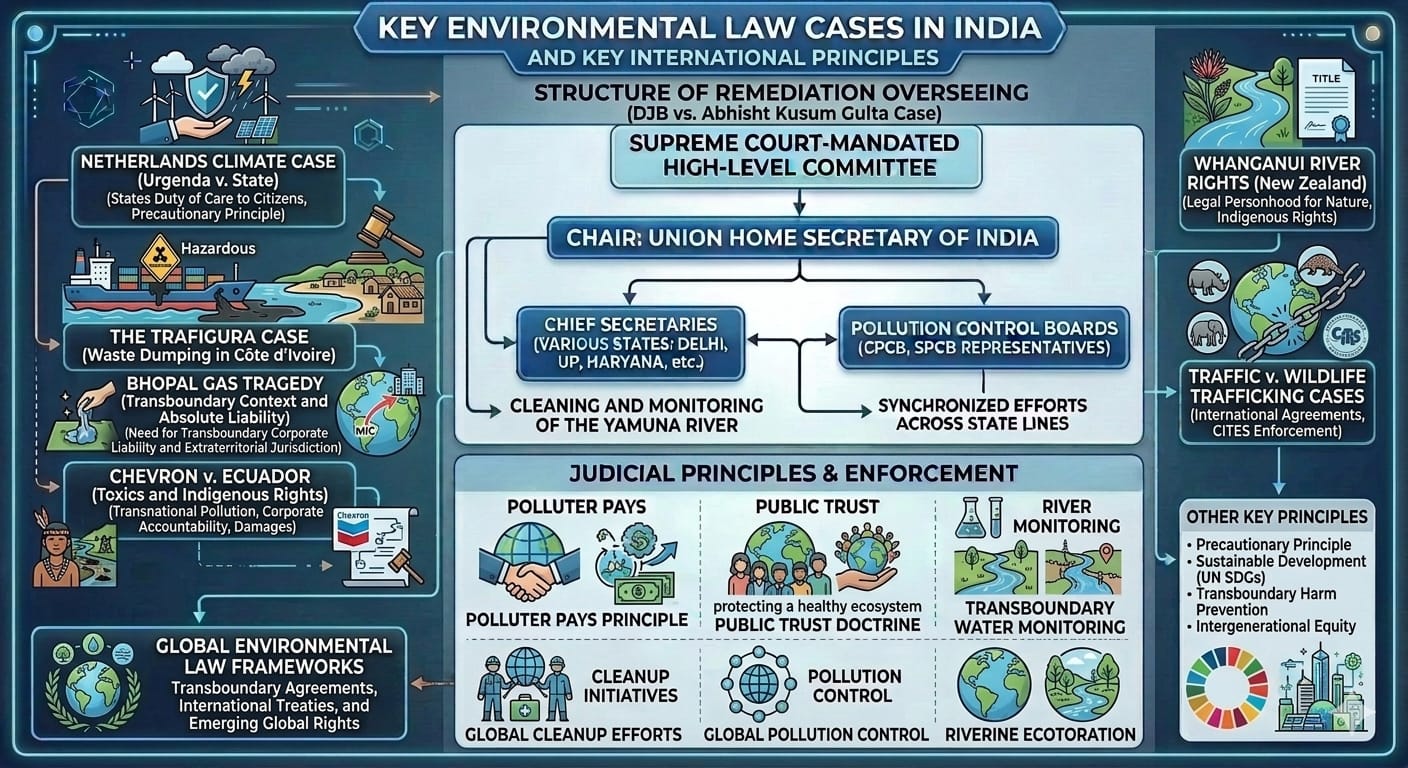
For years, local rivers and irrigation canals have been used as open dumpsters for raw human sewage and toxic industrial waste. It took a landmark legal battle led by environmental activist Abhisht Kusum Gupta before the National Green Tribunal (NGT) to tear away bureaucratic denial and expose the systemic infrastructure failures choking the region’s water.
While the litigation sparked a regulatory earthquake, a critical question remains: Has it actually made our water cleaner?
The Blueprint of a Crisis: What the Litigation Exposed
The case of Abhisht Kusum Gupta v. State of Uttar Pradesh pulled back the curtain on how civic bodies and real estate developers systematically bypassed environmental laws. The NGT investigation revealed three alarming structural failures:
- The High-Rise Illusion: An audit of 95 high-rise housing societies in Noida revealed that many were occupied without functioning Sewage Treatment Plants (STPs) [susbio]. Instead of treating wastewater, millions of litres of raw sewage were being bypassed straight into urban storm drains.
- Inter-State Toxic Passing: The litigation mapped out how the Delhi Jal Board (DJB), Ghaziabad Nagar Nigam, and the Noida Authority were actively redirecting untreated municipal waste into the Kondli-Noida irrigation canal. This toxic cocktail flows directly into the Hindon River, which eventually feeds the Yamuna and Ganga rivers.
- Industrial Impurity: Over 310 local industries were flagged for dumping chemical-laden effluents into the river basin without utilizing functional Effluent Treatment Plants (ETPs).
Policy Victory vs. Ground Reality: By the Numbers
The legal fallout was massive. The NGT slapped a ₹100 crore environmental compensation fine on the Noida Authority and a ₹50 crore fine on the Delhi Jal Board for historic negligence.
However, the battlefield quickly shifted to the highest court of the land. In the civil appeal Delhi Jal Board v. Abhisht Kusum Gupta & Ors., the Supreme Court of India stepped in. While the apex court stayed the immediate execution of the ₹150 crore monetary penalties during the appeal process, it crucially upheld the structural mandates for an immediate environmental cleanup. The court made it clear: fiscal delays cannot be used as an excuse to pause ecological restoration.
Yet, if you look at the latest water quality metrics from the Central Pollution Control Board (CPCB), the Hindon River remains ecologically dead:
- Dissolved Oxygen (DO): 0.76 to 4.30 mg/L (Healthy standard is > 5.0 mg/L). In multiple stretches, DO drops to near zero, making aquatic life impossible.
- Biological Oxygen Demand (BOD): 25.0 to 206.67 mg/L (Safe bathing limit is < 3.0 mg/L).
- Chemical Oxygen Demand (COD): 82.0 to 456.67 mg/L, proving that unchecked chemical dumping continues unabated.
Why the gap? Because while court orders are strict, execution lags. Builders and civic bodies continue to hide behind legal delays, claiming that upgrading legacy infrastructure requires more time, while new public STPs remain stuck in endless "trial runs."
A Global Echo: Mirroring International Waters
Noida’s toxic crisis is not unique; it mirrors deep-rooted global battles where urbanisation outpaced environmental enforcement.
- The Inter-State Blame Game (The Rhine River Crisis): The cross-border finger-pointing between Delhi and Uttar Pradesh echoes the historic Rhine River pollution disputes in Europe. For decades, France, Germany, and the Netherlands deflected blame for chemical and municipal dumping. It took the Rhine Action Programme (1987)to force cross-border accountability—proving that rivers cannot be cleaned until adjacent states stop using them as geopolitical boundary lines for waste.
- The High-Rise Failure (The London 'Super Sewer' Battle): Noida’s issue of raw sewage bypassing into storm drains mirrors London’s crisis with its Victorian-era sewage system. London's growth led to millions of tonnes of raw sewage overflowing into the River Thames during heavy rains. This triggered massive regulatory penalties and forced the UK to construct the multi-billion-pound Thames Tideway Tunnel—proving that localized, sub-standard fixes cannot handle mega-city densities.
The Blame Game: Builders vs. Residents
The most immediate impact of the Abhisht Gupta litigation is being felt by everyday high-rise residents. To dodge future NGT penalties, the Noida Authority has started enforcing its building bylaws strictly [susbio]. Any housing project spanning over 20,000 square metres must run an in-house STP that meets stringent parameters (BOD ≤ 10 mg/L) [susbio].
When these STPs fail, the Noida Authority has begun filing criminal FIRs. This has triggered an intense legal battle between Apartment Owners Associations (AOAs) and real estate developers. Residents argue that builders handed over fundamentally flawed or incomplete STP infrastructure, leaving citizens legally vulnerable to criminal prosecution for environmental pollution.
The Road Ahead: Turning Legal Battles into Clean Water
Abhisht Kusum Gupta’s litigation represents a massive milestone. It stripped away bureaucratic excuses and created a roadmap—including a new plan to turn Noida into a "Zero Discharge City" through the construction of 11 new localized STPs [plan].
However, court orders alone cannot clean a river. Real change will only happen when:
- Developer Accountability: Real estate developers are held criminally liable for delivering faulty STP infrastructure.
- Cooperative Federalism: Cross-border civic agencies stop blaming adjacent states and cooperate on waste management, as mandated in the Delhi Jal Board Supreme Court appeal.
- Citizen Surveillance: Citizen groups actively monitor local drains and use platforms like the CPCB’s "Sameer App" or the NGT e-portal to report illegal bypasses [cpcb].
#Noida #HindonRiver #Yamuna #DelhiJal Board #NationalGreenTribunal #SupremeCourt #AbhishtKusumGupta #EcoCrisis #SaveOurRivers #ZeroDischargeCity#EnvironmentalLaw #SustainableDevelopment #UrbanPlanning #SmartCities #WaterManagement #SupremeCourtOfIndia #PublicInterestLitigation #CorporateAccountability #NoidaAuthority #RealEstateIndia#NoidaDiaries #DelhiNCR #SaveHindon #EnvironmentMatters #PollutionCrisis #CleanWaterNow #EcoActivism #GoGreenNoida #HighRiseLiving #WaterPollution #ClimateActionIndia

{{item.comment}}
{{item.name}}
{{item.postDate}}