
From One Polluted Drain to National Environmental Accountability: The Legacy of OA No. 1002 of 2018
Environmental litigation often begins with a local problem but can ultimately reshape national policy. Original Application No. 1002 of 2018 – Abhisht Kusum Gupta vs. State of Uttar Pradesh & Others is one such landmark case before the National Green Tribunal (NGT). What began as a grievance over the discharge of untreated sewage into the Kondli Storm Water Drain adjoining Sector 137, Noida, evolved into a case that significantly influenced environmental governance, sewage management, environmental compensation, and river restoration across India.
The Beginning
The application highlighted that the Kondli Storm Water Drain, originally intended to carry stormwater, had become a conduit for untreated sewage from residential colonies, commercial establishments, industries, and upstream urban areas. The polluted water ultimately flowed into the Yamuna River, affecting downstream ecosystems and public health.
Recognizing that the issue extended far beyond a single drain, the National Green Tribunal expanded its examination to include:
-
Untreated sewage management
-
Industrial pollution
-
Storm water drain protection
-
River rejuvenation
-
Accountability of statutory authorities
-
Compliance with the Water (Prevention and Control of Pollution) Act, 1974
-
Environmental restoration under the Polluter Pays Principle
Numerous authorities, including CPCB, UPPCB, Delhi Jal Board, NOIDA Authority, the Governments of Uttar Pradesh and Delhi, and other agencies, were directed to take remedial measures.
A Landmark Shift in Environmental Jurisprudence
The Tribunal observed that storm water drains and irrigation canals are public water resources and cannot be converted into sewage carriers.
The Tribunal directed authorities to:
-
Prevent discharge of untreated sewage into drains.
-
Divert sewage to Sewage Treatment Plants (STPs).
-
Reuse treated wastewater.
-
Restore polluted drains.
-
Ensure accountability of polluting agencies.
-
Strengthen environmental monitoring.
These directions reinforced the constitutional principles of sustainable development and the Polluter Pays Principle.
Evolution of Environmental Compensation
One of the most significant outcomes of OA No. 1002 of 2018 was the application and refinement of environmental compensation for failure to treat sewage.
The Tribunal applied a methodology that included ₹2 crore per MLD (Million Litres per Day) of untreated sewage, providing an objective basis for assessing environmental damage and funding ecological restoration.
This approach subsequently became an important reference point in later nationwide environmental compliance proceedings concerning sewage and municipal waste management.
From Noida to National Impact
The principles developed in OA No. 1002 of 2018 influenced subsequent nationwide proceedings before the National Green Tribunal, particularly OA No. 606 of 2018, where environmental compensation was assessed against States for failures in sewage treatment and municipal waste management.
The major environmental compensation imposed by the Tribunal included:
| State / UT | Environmental Compensation (₹ Crore) | Supreme Court Status |
|---|---|---|
| Tamil Nadu | 15,419.71 | Appeal pending |
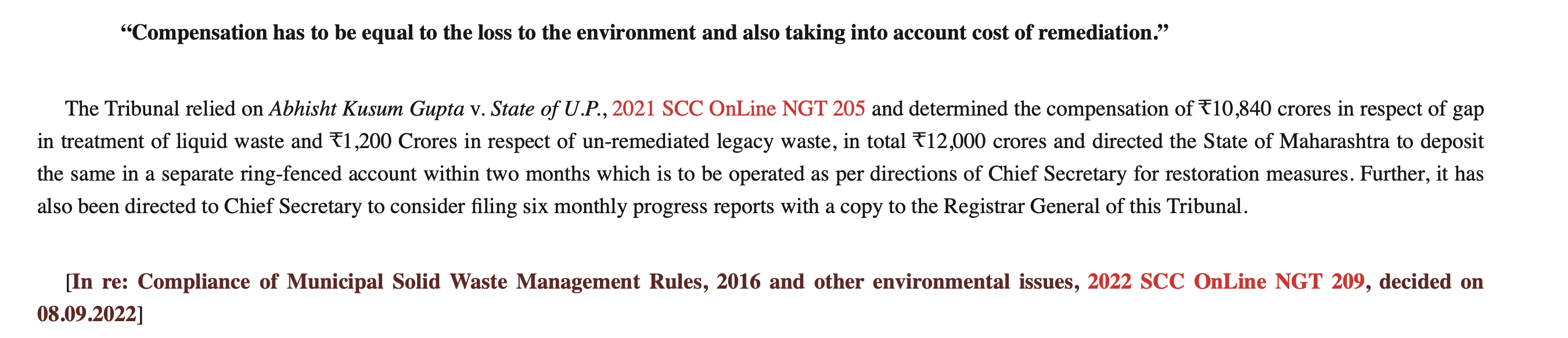
| Maharashtra | 12,000.00 | Interim protection granted |
| Uttar Pradesh | 5,000.00 | Proceedings pending |
| Telangana | 3,800.00 | Pending |
| West Bengal | 3,346.00 | Pending |
| Rajasthan | 3,000.00 | Interim stay granted |
| Punjab | 2,180.00 | Pending |
| Odisha | 1,152.00 | Pending |
| Tripura | 382.50 | Pending |
| Meghalaya | 234.05 | Pending |
| Manipur | 200.00 | Pending |
| Nagaland | 200.00 | Pending |
| Uttarakhand | 200.00 | Pending |
| Puducherry | 178.92 | Pending |
| Mizoram | 50.00 | Pending |
| Sikkim | 50.00 | Pending |
Total Environmental Compensation Assessed by the NGT: ₹79,234.36 Crore
These proceedings marked one of the largest exercises of environmental accountability undertaken by the National Green Tribunal.
Connected Supreme Court Proceedings
Several authorities challenged the NGT's directions before the Hon'ble Supreme Court.
The principal appeals connected with OA No. 1002 of 2018 include:
| Civil Appeal | Appellant | Status |
|---|---|---|
| Civil Appeal Nos. 8547–8548 of 2022 | New Okhla Industrial Development Authority (NOIDA) | Pending before the Supreme Court |
| Civil Appeal Nos. 8967–8968 of 2022 | Delhi Jal Board | Pending before the Supreme Court |
Similarly, several States challenged the environmental compensation imposed in OA No. 606 of 2018 and connected matters. Appeals by Maharashtra, Rajasthan, Tamil Nadu, Uttar Pradesh and other States continue to be considered by the Hon'ble Supreme Court, with interim protection granted in some cases.
Lasting Contributions of OA No. 1002 of 2018
The case has contributed significantly to environmental governance in India by:
-
Recognising storm water drains as environmentally protected public water bodies.
-
Reinforcing that untreated sewage cannot be discharged into rivers or drains.
-
Strengthening enforcement of the Polluter Pays Principle.
-
Encouraging scientific assessment of environmental compensation.
-
Improving accountability of urban local bodies and development authorities.
-
Promoting sewage treatment and reuse.
-
Supporting restoration of the Yamuna River and connected drainage systems.
-
Influencing subsequent nationwide environmental compliance proceedings.
A Landmark Citizen-Led Environmental Case
OA No. 1002 of 2018 demonstrates how citizen-led environmental litigation can lead to systemic reforms. A case that originated from pollution in a single storm water drain in Noida has contributed to wider discussions on sewage management, river rejuvenation, environmental compensation, and institutional accountability.
While the nationwide compensation imposed on States arose in subsequent proceedings, the legal principles developed and applied through cases such as OA No. 1002 of 2018 have become an important part of India's environmental jurisprudence.
The case continues to be monitored through ongoing proceedings before the National Green Tribunal and the Hon'ble Supreme Court, reflecting the continuing importance of protecting rivers, storm water drains, wetlands, and urban ecosystems for present and future generations.
#AbhishtKusumGupta #OA1002of2018 #NationalGreenTribunal #NGT #EnvironmentalJustice #EnvironmentalLaw #PolluterPays #RiverRestoration #Yamuna #HindonRiver #KondliStormWaterDrain #WaterConservation #CleanRivers #WastewaterManagement #SewageTreatment #EcologicalRestoration #WetlandConservation #UrbanEcology #Biodiversity #ClimateAction #EnvironmentalGovernance #PublicInterestLitigation #CitizenAction #SustainableDevelopment #Noida #UttarPradesh #EnvironmentalProtection #TeamVolunteers137 #Volunteers137 #RestoreNature

{{item.comment}}
{{item.name}}
{{item.postDate}}