
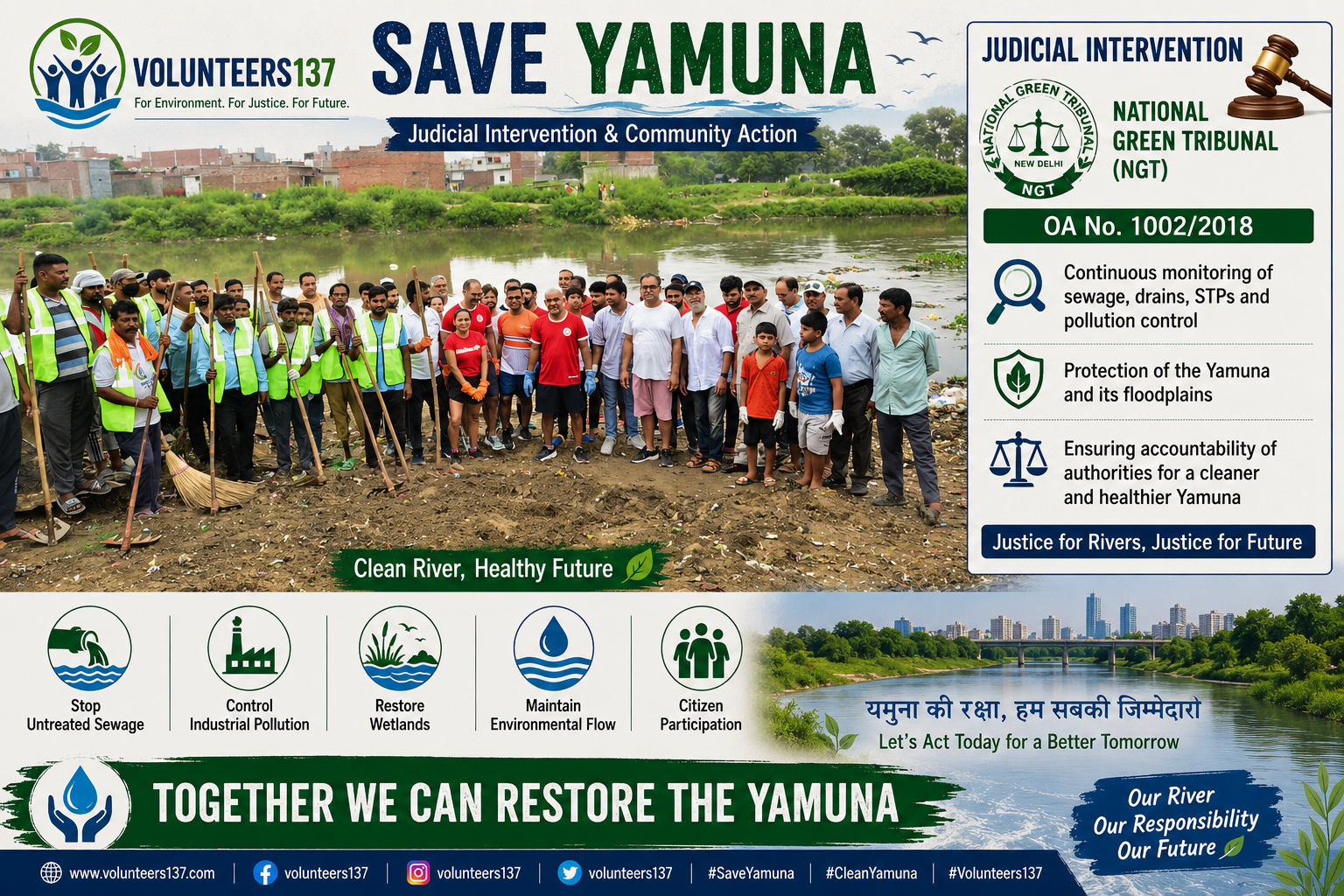
Cleaning the Yamuna: A Basin-Wide Mission Across States and Districts
The Yamuna River is India's second-largest tributary of the Ganga and supports nearly 60 million people across northern India. Stretching approximately 1,376 kilometres from the Yamunotri Glacier in Uttarakhand to its confluence with the Ganga at Prayagraj (Allahabad), Uttar Pradesh, the river traverses multiple states, hundreds of towns, and numerous districts. Protecting this river requires cooperation at every administrative level—from Himalayan catchments to the fertile Indo-Gangetic plains.
The river originates in Uttarkashi district of Uttarakhand, flowing through the Himalayan region before forming parts of the boundary between Himachal Pradesh and Haryana. It then passes through or influences the National Capital Territory of Delhi before entering Uttar Pradesh, where it eventually meets the Ganga. Major tributaries such as the Hindon, Chambal, Sindh, Betwa, Ken, Tons, Giri, Asan, Kali-West, Krishni, and Dhamola further expand the Yamuna basin into Madhya Pradesh and Rajasthan.
States and Major Districts Involved in the Yamuna Basin
Uttarakhand
-
Uttarkashi (origin at Yamunotri)
-
Dehradun
Himachal Pradesh
-
Sirmaur
-
Shimla (upper catchment)
-
Solan (tributary catchments)
Haryana
-
Yamunanagar
-
Karnal
-
Panipat
-
Sonipat
-
Kurukshetra
-
Ambala
-
Faridabad
-
Palwal
National Capital Territory of Delhi
-
North Delhi
-
North-East Delhi
-
East Delhi
-
Central Delhi
-
Shahdara
-
South-East Delhi
-
South Delhi
-
South-West Delhi
Uttar Pradesh
The Yamuna directly or indirectly influences several districts, including:
-
Saharanpur
-
Shamli
-
Muzaffarnagar
-
Baghpat
-
Meerut
-
Ghaziabad
-
Gautam Buddha Nagar (Noida & Greater Noida)
-
Bulandshahr
-
Aligarh
-
Mathura
-
Agra
-
Firozabad
-
Etawah
-
Auraiya
-
Jalaun
-
Hamirpur
-
Banda
-
Kaushambi
-
Prayagraj
The CPCB-Hindon restoration report specifically identifies the following districts for pollution mapping and restoration activities:
-
Saharanpur
-
Shamli
-
Muzaffarnagar
-
Meerut
-
Baghpat
-
Ghaziabad
-
Gautam Buddha Nagar
These districts contribute significantly to pollution entering the Yamuna through the Hindon River and its tributaries Dhamola, Kali-West, and Krishni.
Rajasthan (through the Chambal Basin)
-
Kota
-
Bundi
-
Sawai Madhopur
-
Dholpur
-
Karauli
-
Baran
-
Jhalawar
Madhya Pradesh (through major tributaries)
-
Morena
-
Bhind
-
Sheopur
-
Gwalior
-
Shivpuri
-
Vidisha
-
Raisen
-
Sagar
-
Chhatarpur
-
Tikamgarh
-
Panna
-
Damoh
Why Every District Matters
Pollution generated in upstream districts eventually reaches downstream communities. For example:
-
Untreated sewage from Saharanpur, Muzaffarnagar, Meerut, Ghaziabad, and Noida enters the Hindon River before finally reaching the Yamuna.
-
Industrial wastewater from paper mills, sugar mills, textile units, electroplating industries, and chemical industries significantly increases pollution loads.
-
Urban drains carrying domestic sewage contribute high Biological Oxygen Demand (BOD), reducing dissolved oxygen necessary for aquatic life.
-
Agricultural runoff introduces fertilizers and pesticides into rivers and tributaries.
-
Encroachment of floodplains and destruction of wetlands reduce the river's natural ability to purify itself.
The CPCB report emphasizes that rejuvenating the Hindon—and consequently improving the Yamuna—requires restoration from source to confluence, including pollution mapping, sewage interception, industrial compliance, groundwater recharge, wetland restoration, biodiversity conservation, riparian plantation, and continuous monitoring across every district in the basin.
A Basin-Level Strategy
The report makes it clear that cleaning the Yamuna cannot be achieved by Delhi alone or by constructing additional sewage treatment plants. Instead, success depends on coordinated action involving all basin states, district administrations, pollution control boards, urban local bodies, irrigation departments, groundwater agencies, industries, and local communities.
Only a basin-wide approach that integrates pollution prevention, ecological restoration, sustainable water management, and continuous scientific monitoring can restore the Yamuna to a healthy and self-sustaining river ecosystem.
#Yamuna #YamunaRiver #CleanYamuna #SaveYamuna #RiverRejuvenation #RiverRestoration #CleanRivers #WaterConservation #WaterPollution #EnvironmentalProtection #SustainableDevelopment #NatureBasedSolutions #WetlandRestoration #GroundwaterRecharge #EnvironmentalFlow #Biodiversity #ClimateAction #RiverBasinManagement #HindonRiver #ChambalRiver #BetwaRiver #KenRiver #KaliWest #KrishniRiver #CPCB #NGT #NMCG #IndiaEnvironment #EcoRestoration #CleanIndia

{{item.comment}}
{{item.name}}
{{item.postDate}}