
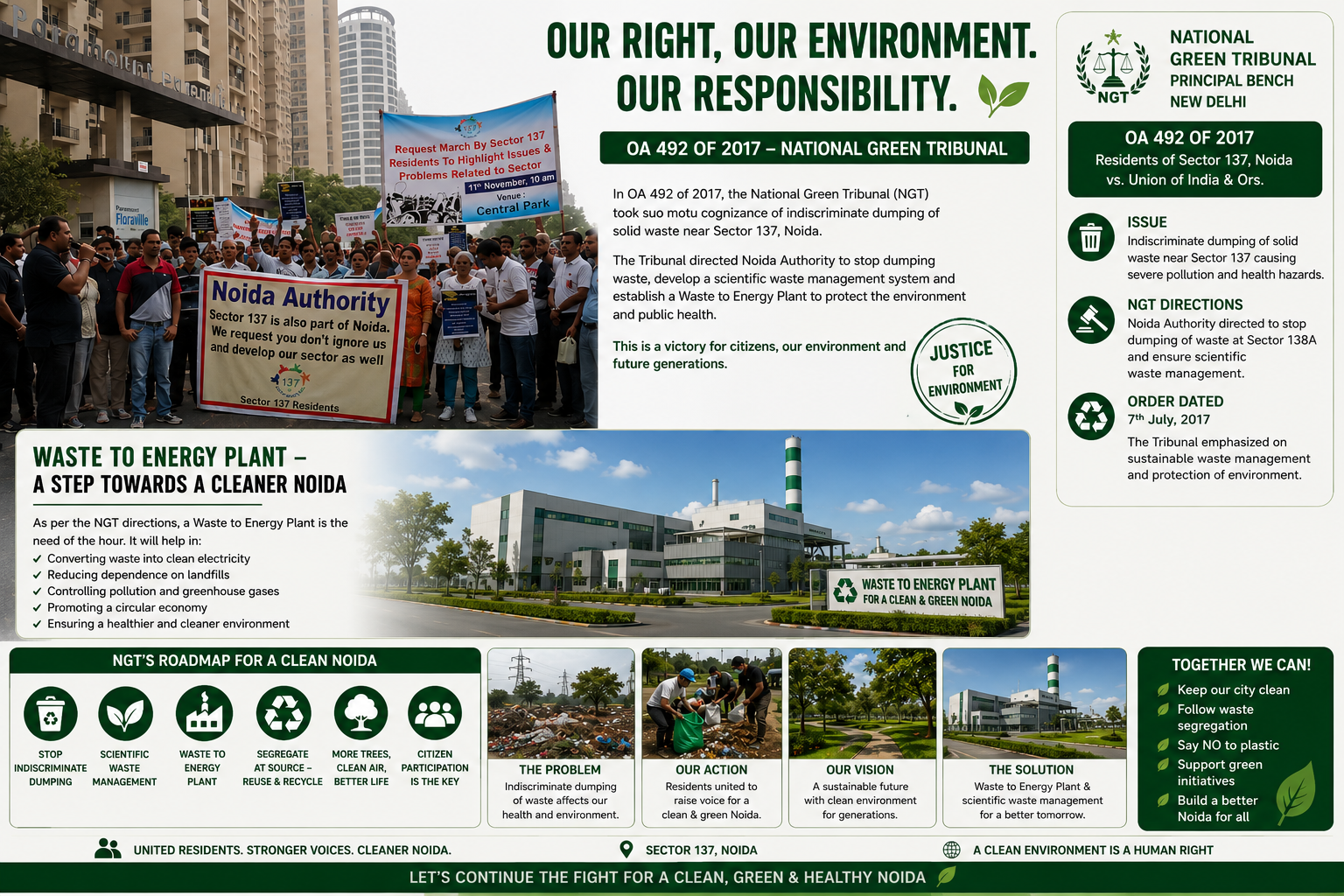
From Waste to Wealth: Why Noida Needs a Modern Waste-to-Energy Plant
Noida has grown into one of India's most dynamic urban and industrial centres. However, with rapid urbanization comes the challenge of managing thousands of tonnes of municipal solid waste every day. Sustainable waste management is no longer an option—it is a necessity.
Recognizing this challenge, the National Green Tribunal (NGT), in Original Application (OA) No. 492 of 2017, emphasized the need for scientific solid waste management and directed the Noida Authority to develop appropriate waste-processing infrastructure, including a Waste-to-Energy (WTE) Plant, to reduce dependence on open dumping and landfills.
Why a Waste-to-Energy Plant?
A modern Waste-to-Energy plant converts non-recyclable municipal solid waste into electricity or usable energy through environmentally regulated technologies. Instead of allowing waste to accumulate in landfill sites, it is processed scientifically, reducing pollution while generating clean energy.
Key Benefits
1. Scientific Waste Disposal
-
Reduces dependence on landfills.
-
Prevents illegal dumping.
-
Minimizes methane emissions from decomposing waste.
2. Renewable Energy Generation
-
Converts municipal waste into electricity.
-
Supports India's clean energy goals.
-
Reduces dependence on fossil fuels.
3. Cleaner Air and Water
Scientific waste processing helps prevent:
-
Leachate contaminating groundwater.
-
Open burning of waste.
-
Foul odours.
-
Air pollution from unmanaged dumpsites.
4. Land Conservation
Landfills occupy valuable urban land for decades. Waste-to-Energy technology can reduce waste volume by nearly 90%, significantly extending landfill life.
5. Circular Economy
A modern waste management ecosystem integrates:
-
Source segregation.
-
Material Recovery Facilities (MRFs).
-
Recycling of plastics, paper, metals, and glass.
-
Composting of biodegradable waste.
-
Waste-to-Energy for non-recyclable residual waste.
This ensures that every fraction of waste is managed efficiently.
Learning from Global Cities
Cities such as Singapore, Copenhagen, Tokyo, and Stockholm have demonstrated that Waste-to-Energy plants can coexist with urban development when equipped with advanced emission control systems and supported by effective waste segregation.
These cities have transformed waste from an environmental burden into a valuable energy resource while maintaining high environmental standards.
The Roadmap for Noida
To become a model sustainable city, Noida should focus on:
-
Segregation of waste at source.
-
Strengthening door-to-door collection.
-
Expanding recycling infrastructure.
-
Promoting decentralized composting.
-
Developing a modern Waste-to-Energy facility for non-recyclable waste.
-
Increasing green cover around waste management facilities.
-
Continuous environmental monitoring and public transparency.
Community Participation is Essential
Infrastructure alone cannot solve the waste challenge. Residents, industries, Resident Welfare Associations (RWAs), schools, and businesses all have a role to play by reducing waste generation, segregating waste at source, avoiding single-use plastics, and supporting recycling initiatives.
A Vision for a Sustainable Noida
A modern Waste-to-Energy plant should not be viewed merely as a waste disposal facility—it should become part of an integrated resource recovery system that transforms waste into electricity, conserves land, reduces pollution, and contributes to a circular economy.
With scientific planning, strong environmental safeguards, and active citizen participation, Noida can become a national model for sustainable urban waste management.
A cleaner city is built when waste is seen not as a problem, but as a resource waiting to be transformed.
#WasteToEnergy #GreenNoida #OA492of2017 #NGT #CircularEconomy #SolidWasteManagement #RenewableEnergy #ZeroWaste #SustainableCities #CleanIndia #EnvironmentalGovernance #SmartCity #ClimateAction

{{item.comment}}
{{item.name}}
{{item.postDate}}